A pattern row like k2, ssk, yo, k1, yo, k2tog, k2 looks like gibberish until you figure out it's a short form (called an abbreviation) of a long instruction — basically a compressed sentence. There are a hundred if not more of them for knitting, and it really takes time to memorise them all.
Below, we present you with all knitting abbreviations, grouped so you can find things by purpose. Bookmark it, or keep it open in a second tab while you work. There's a crochet abbreviations cheat sheet too if you need it.
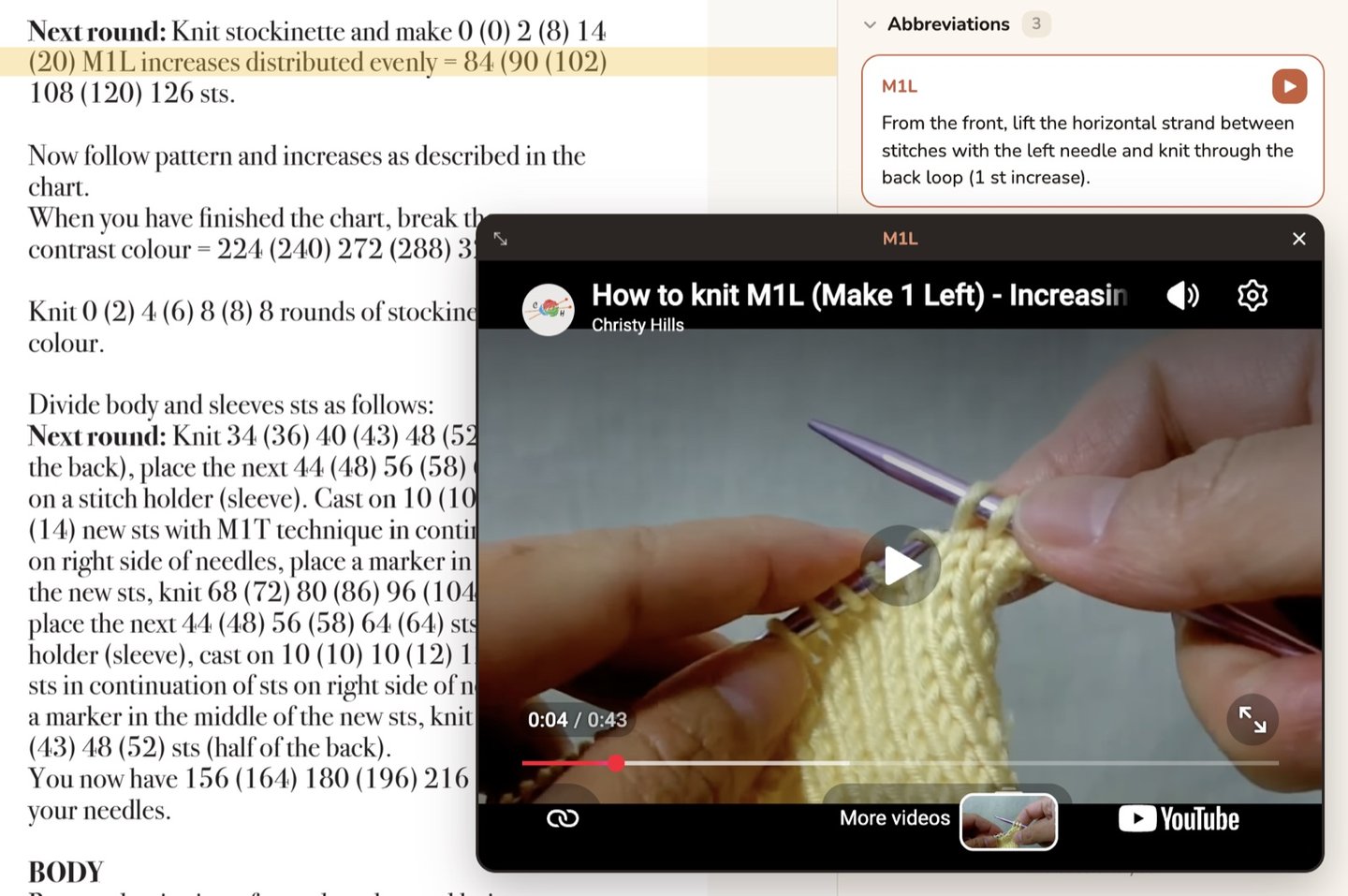
However, at Twizzory, we take them seriously, and for each pattern you start working on, we detect all its abbreviations and extract them for you — the whole list, including a description and an embedded YouTube video, so you don't need to look them up in a separate tab, distracting yourself further.
How pattern abbreviation works
Four rules cover almost everything you'll meet.
- A number after an abbreviation is a count.
k2means knit two stitches. - Commas separate steps in order. Work them left to right, exactly as written, until the row runs out.
- Brackets and parentheses group a repeat.
(k1, p1) 6 timesmeans work that pair six times over, using twelve stitches. - Asterisks mark a repeat that runs to the end.
*k2, p2; rep from * to endmeans keep alternating until you run out of row.
The number in brackets at the end of a row — (48 sts) — is your checksum. If you don't have that many stitches, stop and find out why before working the next row.
Generic abbreviations
These aren't specific to one craft, you'll meet them whether you're holding needles or a hook.
| Abbreviation | What it means |
|---|---|
| * | Repeat instructions following the asterisk as many times as instructed |
| alt | Alternate |
| approx | Approximately |
| beg | Beginning |
| bet | Between |
| CC | Contrasting color |
| ch | Chain stitch |
| cm | Centimetres |
| cont | Continue (ing) |
| dc | Double crochet |
| dc2tog | (insert hook into next stitch, yarn over hook, pull through loop) twice, yarn over hook, pull through all three loops on hook |
| dec | Decrease (ing) |
| dtr | Double treble crochet |
| htr | Half treble crochet |
| inc | Increase (ing) |
| m | Marker |
| MC | Main color |
| mm | Millimetres |
| pm | Place marker |
| prev | Previous |
| rem | Remain (ing) |
| rep | Repeat (ing) |
| rnd(s) | Round(s) |
| RS | Right side |
| sl st | Slip stitch |
| sp(s) | Space(s) |
| tbl | Through the back loop(s) |
| tog | Together |
| tr | Treble crochet |
| WS | Wrong side |
| yo | Yarn over; work yfwd/yon/yrn as appropriate |
| yoh | Yarn over hook |
Know which side you're on. Everything else in this table only makes sense once you know whether you're working a RS or WS row.
Stitches, fabric and tools
The building blocks: needles, stitches and the finishing moves.
| Abbreviation | What it means |
|---|---|
| k | Knit |
| p | Purl |
| st(s) | Stitch(es) |
| st st | Stocking / stockinette stitch (k on RS row, p on WS row) |
| rev st st | Reverse stocking / stockinette stitch (p on RS row, k on WS row) |
| g st | Garter stitch (knit every row when flat; knit one round and purl the next in the round) |
| patt | Pattern |
| kwise | Knitwise |
| pwise | Purlwise |
| tfl | Through the front loop(s) |
| lp | Loop |
| k1B | Knit stitch in row below |
| P1B | Purl stitch in row below |
| KPKPK | Knit, purl, knit, purl, knit into the same stitch |
| CO | Cast on |
| BO | Bind off |
| cast off | Cast off (UK); bind off |
| 3-needle BO | Three-needle bind off: join two sets of live stitches while binding them off together |
| Kitchener st | Kitchener stitch; graft two sets of live stitches together invisibly |
| PUK | Pick up and knit stitches along an edge |
| seam | Join two pieces of knitted fabric |
| block | Wet or steam the finished piece to even the stitches and set its shape |
| tension | Tension (UK); stitches and rows over a given measurement, usually 10 cm — gauge in US patterns |
| cn | Cable needle |
| dpn(s) | Double pointed needle(s) |
| circ | Circular needle; two tips joined by a flexible cable |
| N1 (2, 3) | Needle 1 (2, 3) |
| LH | Left hand |
| RH | Right hand |
| meas | Measure (s) |
| foll(s) | Following (follows) |
| sm | Slip marker |
| rm | Remove marker |
| pb | Place bead |
| ch sp | Chain space |
| BOR | Beginning of round |
| end | End of the row or round |
| C1 (2, 3) | Colour 1 (2, 3) |
| 0 | No stitches, times or rows |
| - | No stitches, times or rows for that size |
| ()[] | Work instructions inside the brackets as many times as instructed in pattern |
Not all of these are stitches. Kitchener st and 3-needle BO are ways of joining live stitches, not something you work row by row.
Increases
Every one of these adds a stitch. They differ in where the new stitch sits, which way it leans, and how visible the resulting hole is.
| Abbreviation | What it means |
|---|---|
| kfb | Knit into the front and the back of next stitch; single knit increase |
| kfbf | Knit into the front, back and front of the next stitch |
| pfb | Purl into the front and back of next st; single purl increase |
| m1 | Make one stitch, by picking up the horizontal loop before next stitch and knitting into the back of it |
| M1K | Make one stitch knitwise; single knit increase |
| M1L | From the front, lift the horizontal strand between stitches with the left needle and knit through the back loop (1 st increase). |
| M1R | From the back, lift the horizontal strand between the two stitches with the left needle and knit through the front loop (1 st increase). |
| m1p | Make one stitch, by picking up the horizontal loop before next stitch and purling into the back of it; single purl increase |
| M1lp | Make one left purlwise; single left-leaning purl increase |
| M1rp | Make one right purlwise; single right-leaning purl increase |
| inc1 | Increase one by knitting into the front and back of the same stitch; single knit increase |
| inc1p | Increase one by purling into the front and back of the same stitch; single purl increase |
| byo | Backward yarn over |
Pick based on visibility. M1 variants pick up the bar between stitches and leave no trace; kfb works twice into one stitch and leaves a small bump.
Decreases
Each of these removes a stitch. Which one you use depends on which way it needs to lean.
| Abbreviation | What it means |
|---|---|
| k2tog | Knit two stitches together; single right-leaning decrease |
| k3tog | Knit three stitches together; double right-leaning decrease |
| p2tog | Purl two stitches together; single right-leaning decrease |
| ssk | Slip 2 stitches knitwise, one by one, then knit these 2 stitches together through the back loops; single left-leaning decrease |
| ssp | Slip 2 stitches knitwise, return these 2 stitches to left needle and purl them together through back loops; single left-leaning decrease |
| sssk | Slip 3 stitches knitwise, knit these 3 stitches together through back loops; double left-leaning decrease |
| sssp | Slip 3 stitches knitwise, return these 3 stitches to left needle and purl these 3 stitches together through back loops; double left-leaning decrease |
| skpo | Slip one, knit one, pass slipped stitch over |
| SKP | Slip 1 knitwise, knit 1, pass slip stitch over knit stitch; single left-leaning decrease |
| Sl1 k1 psso | Slip 1 stitch purlwise, knit 1 stitch, and pass the slipped stitch over the knitted stitch. |
| ksp | Knit 1 stitch, slip this stitch from right needle to left needle, pass second stitch on left needle over first stitch and off left needle; return stitch to right needle; single right-leaning decrease |
| sk2po | Slip next stitch kwise, knit two together, pass slipped stitch over and off needle |
| SK2P | Slip 1 knitwise, knit 2 together, pass slip stitch over knit 2 together; double left-leaning decrease |
| s2kpo | Slip two, knit one, pass slipped stitches over; centered double decrease |
| S2KP | Slip two stitches together knitwise, knit one, pass the slipped stitches over; centered double decrease |
| S2KP2 | Slip 2 stitches as if to knit 2 together, knit 1, pass 2 slipped stitches over knit stitch; centered double decrease |
| CDD | Centered double decrease; removes two stitches and keeps the centre stitch on top |
| SSPP2 | Slip 2 stitches knitwise, return these 2 stitches to left needle and then slip them as if to p2tog through back loops, purl 1, pass 2 slipped stitches over purl stitch; centered double decrease |
| psso | Pass slipped stitch over and off needle |
| p2sso | Pass two slipped stitches over and off needle |
| PKSO | Pass knit stitch over the stitch just worked and off the needle |
| sl 2, k1, p2sso | Slip next two stitches knitwise at the same time, knit one, pass both slipped stitches over |
Single, double, centred. A single decrease removes one stitch, a double removes two. Centred double decreases like S2KP2 keep the middle stitch on top and are what give a raglan seam or a shawl spine its crisp vertical line — swapping in a plain sk2po will visibly change the look.
Slipping, yarn position and short rows
These control where the working yarn sits rather than making a stitch of their own.
| Abbreviation | What it means |
|---|---|
| sl | Slip |
| sl 1 | Slip one stitch; check whether the pattern specifies knitwise or purlwise |
| sl1k | Slip 1 knitwise; this twists the stitch |
| sl1p | Slip 1 purlwise; keeps the stitch untwisted |
| wyib | With yarn in back |
| wyif | With yarn in front |
| yb | Yarn back |
| yf | Yarn forward |
| yfwd | Yarn forward (between knit stitches) |
| yon | Yarn over needle (between a purl and a knit stitch) |
| yrn | Yarn round needle (between purl stitches and between a knit and a purl stitch) |
| y2rn | Wrap yarn twice around needle |
| yos | Yarn over slip; bring yarn forward, slip a stitch purlwise, carry yarn back over the right needle |
| yfrn | Yarn forward round needle |
| w&t | Wrap and turn. On knit rows: take the yarn between the needles to the front of the work, slip the next stitch from the left hand needle to the right hand needle purlwise, take the yarn between the needles back to its original position, slip the stitch back to the left hand needle and turn. On purl rows: take the yarn between the needles to the back of the work, slip the next stitch from the left hand needle to the right hand needle purlwise, take the yarn between the needles back to its original position, slip the stitch back to the left hand needle and turn |
| k wrap tog with st | Insert right hand needle up through the wrap and into the stitch, knit the wrap together with stitch |
| p wrap tog with st | Slip the wrapped stitch from the left hand to right hand needle, insert left hand needle into wrap, return stitch to left hand needle, purl wrap and stitch together |
Easy to mix up. Getting wyif and wyib the wrong way round is the usual cause of unexpected floats on the right side of the fabric.
Cables
Cable abbreviations follow a pattern: the number is how many stitches are involved in total, and front or back says where the cable needle is held. Holding at the front makes the cable cross to the left; holding at the back makes it cross to the right.
| Abbreviation | What it means |
|---|---|
| C3F | Cable 3 front: slip two stitches onto cable needle, hold at front of work, k1, k2 from cable needle |
| C3B | Cable 3 back: slip two stitches onto cable needle, hold at back of work, k1, k2 from cable needle |
| C3R | Cable 3 right: slip one stitch onto cable needle, hold at back of work, k2, knit the held stitch |
| C4F | Cable 4 front: slip two stitches on to cable needle, hold at front of work, k2, k2 from cable needle |
| C4B | Cable 4 back: slip two stitches onto cable needle, hold at back of work, k2, k2 from cable needle |
| C6F | Cable 6 front: slip three stitches onto cable needle, hold at front of work, k3, k3 from cable needle |
| C6B | Cable 6 back: slip three stitches onto cable needle, hold at back of work, k3, k3 from cable needle |
| C8F | Cable 8 front: slip four stitches onto cable needle, hold at front of work, k4, k4 from cable needle |
| C8B | Cable 8 back: slip four stitches onto cable needle, hold at back of work, k4, k4 from cable needle |
| T3F | Twist 3 front: travelling stitch worked with the held stitches at the front |
| T3B | Twist 3 back: travelling stitch worked with the held stitches at the back |
| CR2L | Cross two stitches to the left |
| CR2R | Cross two stitches to the right |
| CR3L | Cross 3 left: hold two stitches at the front, p1, then knit the held stitches |
| CR3R | Cross 3 right: hold one stitch at the back, k2, then purl the held stitch |
Cross vs twist. A C-cable fully crosses one group of stitches over another; a T-cable (twist) only crosses part of a stitch, for a smaller movement and a flatter result.
Brioche
Brioche produces a squashy, reversible two-sided rib, and it has its own vocabulary because every "stitch" is really a stitch plus the yarn over sitting with it.
| Abbreviation | What it means |
|---|---|
| brk1 | Brioche knit; knit the next stitch together with its yarn over |
| brk2tog | Brioche knit two together; brioche decrease |
| brp1 | Brioche purl; purl the next stitch together with its yarn over |
| brssk | Brioche slip, slip, knit; slip two stitches and work them together as a brioche knit |
UK vs US vocabulary
Knitting stitches themselves don't change between conventions: k, p, k2tog and ssk mean the same thing everywhere. What changes is the words around them.
| UK term | US term |
|---|---|
| Cast off | Bind off |
| Tension | Gauge |
| Stocking stitch | Stockinette stitch |
If a pattern's stitch abbreviations look exactly like what you already know but a word like "tension" throws you, that's UK vocabulary. The fabric it produces is identical.
Reading a row like a sentence
Put it together. Here's a knitting row:
Row 3 (RS): k1, *k2tog, yo, k1, yo, ssk, k1; rep from * to last st, k1. (61 sts)
Which unpacks as: it's a right-side row. Knit one edge stitch. Then repeat this group until one stitch remains — decrease leaning right, make a hole, knit one, make a hole, decrease leaning left, knit one. Finish with one edge stitch. You should have 61 stitches; the two yarn overs and two decreases in each repeat cancel out, so the count doesn't change.
At Twizzory, we take them seriously, and for each pattern you start working on, we detect all its abbreviations and extract them for you — the whole list, including a description and an embedded YouTube video, so you don't need to look them up in a separate tab, distracting yourself further.