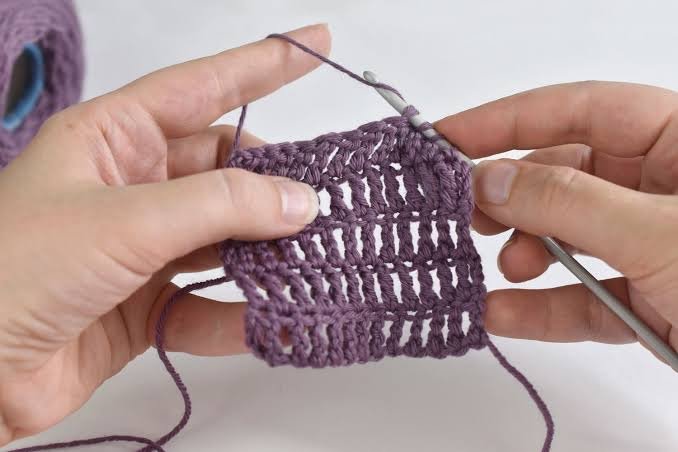
A pattern row like sc2tog, ch 2, dc, FPtr looks like gibberish until you figure out it's a short form (called an abbreviation) of a long instruction — basically a compressed sentence. There are a hundred if not more of them for crochet, and it really takes time to memorise them all.
Below, we present you with all crochet abbreviations, grouped so you can find things by purpose. Bookmark it, or keep it open in a second tab while you work. There's a knitting abbreviations cheat sheet too if you need it.
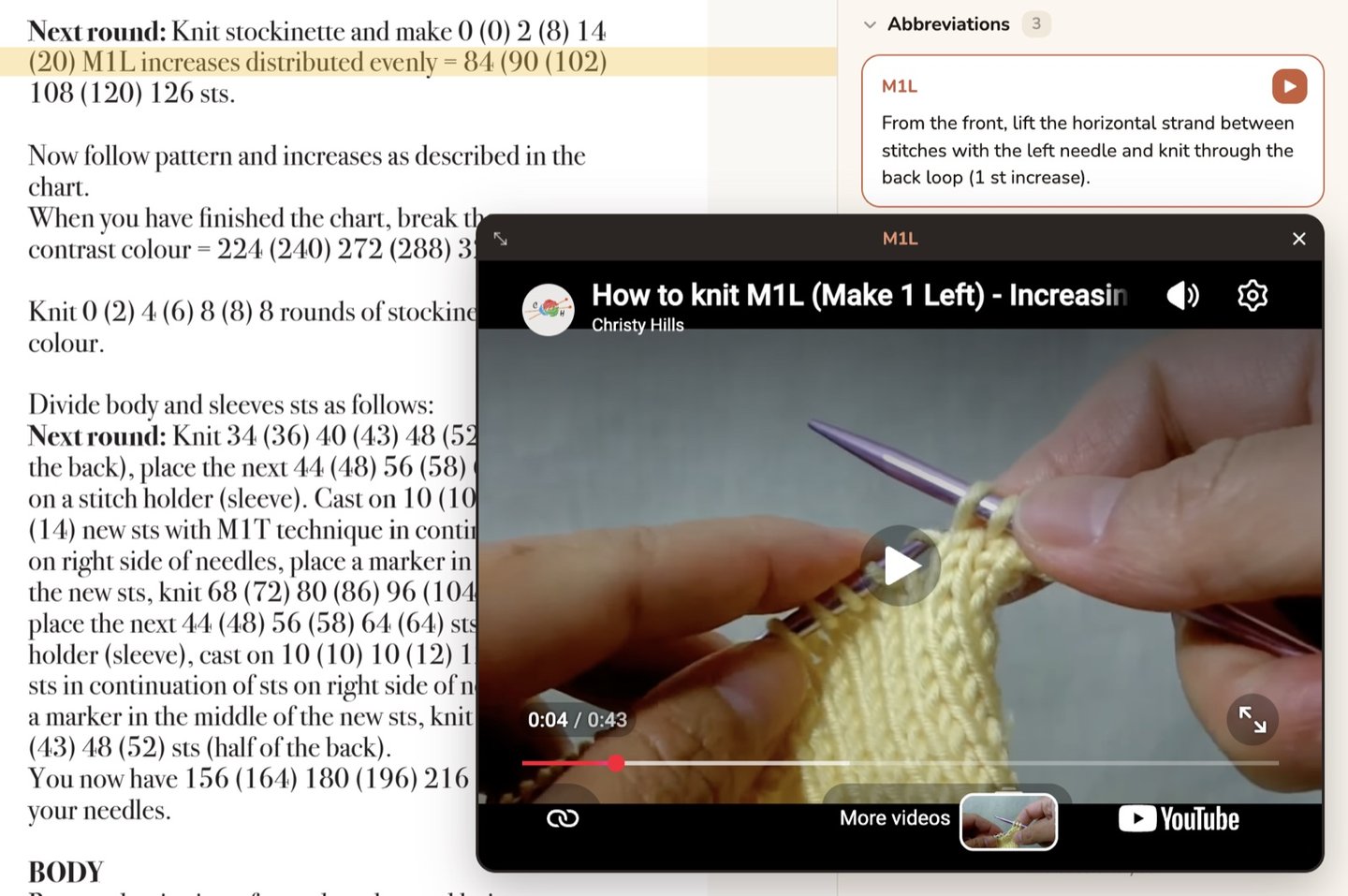
However, at Twizzory, we take them seriously, and for each pattern you start working on, we detect all its abbreviations and extract them for you — the whole list, including a description and an embedded YouTube video, so you don't need to look them up in a separate tab, distracting yourself further.
How pattern abbreviation works
Four rules cover almost everything you'll meet.
- A number after an abbreviation is a count.
sc2means single crochet two stitches. - Commas separate steps in order. Work them left to right, exactly as written, until the row runs out.
- Brackets and parentheses group a repeat.
(dc, ch 1) 6 timesmeans work that pair six times over. - Asterisks mark a repeat that runs to the end.
*sc2, dc2; rep from * to endmeans keep alternating until you run out of row.
The number in brackets at the end of a row — (32 sts) — is your checksum. If you don't have that many stitches, stop and find out why before working the next row.
Generic abbreviations
These aren't specific to one craft, you'll meet them whether you're holding needles or a hook.
| Abbreviation | What it means |
|---|---|
| * | Repeat instructions following the asterisk as many times as instructed |
| alt | Alternate |
| approx | Approximately |
| beg | Beginning |
| bet | Between |
| CC | Contrasting color |
| ch | Chain stitch |
| cm | Centimetres |
| cont | Continue (ing) |
| dc | Double crochet |
| dc2tog | (insert hook into next stitch, yarn over hook, pull through loop) twice, yarn over hook, pull through all three loops on hook |
| dec | Decrease (ing) |
| dtr | Double treble crochet |
| htr | Half treble crochet |
| inc | Increase (ing) |
| m | Marker |
| MC | Main color |
| mm | Millimetres |
| pm | Place marker |
| prev | Previous |
| rem | Remain (ing) |
| rep | Repeat (ing) |
| rnd(s) | Round(s) |
| RS | Right side |
| sl st | Slip stitch |
| sp(s) | Space(s) |
| tbl | Through the back loop(s) |
| tog | Together |
| tr | Treble crochet |
| WS | Wrong side |
| yo | Yarn over; work yfwd/yon/yrn as appropriate |
| yoh | Yarn over hook |
Know which side you're on. Everything else in this table only makes sense once you know whether you're working a RS or WS row.
The basic stitches
Crochet stitch names are height descriptions — each one is a step taller than the last. Everything else in crochet is a variation on these.
| Abbreviation | What it means |
|---|---|
| sc | Single crochet |
| hdc | Half double crochet |
| trtr | Triple treble crochet |
| twtr | Twin treble crochet |
| fsc | Foundation single crochet |
| esc | Extended single crochet |
| edc | Extended double crochet |
| ehdc | Extended half double crochet |
| etr | Extended treble crochet |
| p | Picot |
| picot | A small decorative loop; exact construction depends on the pattern |
| bo | Bobble |
| pc | Popcorn stitch |
| ps/puff | Puff stitch |
| CL | Cluster |
| Cl2 | Cluster, chain one, cluster |
| Cl4 | Four-part cluster; exact construction varies by pattern |
| sh | Shell |
| spike | Spike stitch worked into a lower row or round as specified by the pattern |
Taller with each step. sc is the shortest stitch; hdc, dc, tr, dtr and trtr each add one more wrap of yarn and roughly one more stitch height.
Shaping
Working instructions rather than stitches.
| Abbreviation | What it means |
|---|---|
| sc2tog | Single crochet 2 stitches together |
| sc dec | Single crochet decrease |
| hdc2tog | Half double crochet 2 stitches together |
| dc3tog | Double crochet three stitches together; decreases by two stitches |
| tr2tog | Treble crochet 2 stitches together |
| sk | Skip |
| st | Stitch |
| lp(s) | Loop(s) |
| tch/t-ch | Turning chain |
| ch- | Refers to a specific chain or space previously made |
| ch-sp | Chain space |
| Foundation chain | A group of starting chains |
| foll | Following |
| pat(s)/patt | Pattern |
| sm/sl m | Slip marker |
Turning chain: counts or it doesn't. If tch counts as a stitch, skip the first stitch of the next row; if it doesn't, work into it too.
Post and loop stitches
These say where to insert the hook rather than which stitch to make.
| Abbreviation | What it means |
|---|---|
| FL/FLO | Front loop / front loop only |
| BL/BLO | Back loop / back loop only |
| FP | Front post |
| BP | Back post |
| FPsc | Front post single crochet |
| FPhdc | Front post half double crochet |
| FPdc | Front post double crochet |
| FPtr | Front post treble crochet |
| FPdtr | Front post double treble crochet |
| BPsc | Back post single crochet |
| BPhdc | Back post half double crochet |
| BPdc | Back post double crochet |
| BPtr | Back post treble crochet |
| BPtc | Back post treble crochet |
| BPdtr | Back post double treble crochet |
Post vs loop only. FP/BP wrap around the stem of the stitch below and create the raised ribbing you see on beanies and baskets; FL/BL stitches create horizontal ridges instead.
Tunisian crochet
Tunisian crochet uses a long hook and keeps live loops on it, so each row is worked in two halves: a forward pass that picks loops up, and a return pass that works them off. Its abbreviations nearly all start with t.
| Abbreviation | What it means |
|---|---|
| tss | Tunisian simple stitch |
| tks | Tunisian knit stitch |
| tps | Tunisian purl stitch |
| tsc | Tunisian single crochet |
| thdc | Tunisian half double crochet |
| tdc | Tunisian double crochet |
| ttr | Tunisian treble crochet |
| tslst | Tunisian slip stitch |
| trs | Tunisian reverse stitch |
| tfs | Tunisian full stitch |
| ttw | Tunisian twisted stitch |
| etss | Extended Tunisian simple stitch |
| FwP | Forward pass (Tunisian crochet) |
| RetP | Return pass (Tunisian crochet) |
Colours, units and symbols
The measurements and bracket notation you'll see printed around the actual stitch instructions.
| Abbreviation | What it means |
|---|---|
| CA | Color A |
| CB | Color B |
| g | Gram |
| oz | Ounce(s) |
| yd(s) | Yard(s) |
| " | Inch(es) |
| yrh | Yarn round hook |
| [] | Work instructions within brackets as many times as directed |
| () | Work instructions within parentheses as many times as directed |
| ** | Repeat instructions between asterisks as many times as directed, or repeat from a given set of instructions |
Placeholders, not fixed colors. CA and CB just track which color goes where; the exact colors are yours to choose.
UK vs US vocabulary
This is the single most expensive misunderstanding in crochet, because the patterns still work — they just produce fabric of completely the wrong height.
| UK term | UK abbreviation | US term | US abbreviation |
|---|---|---|---|
| Double crochet | dc | Single crochet | sc |
| Half treble | htr | Half double crochet | hdc |
| Treble | tr | Double crochet | dc |
| Double treble | dtr | Treble | tr |
| Triple treble | trtr | Double treble | dtr |
| Tension | — | Gauge | — |
| Yarn round hook | yrh | Yarn over | yo |
Two quick ways to tell which convention a pattern uses:
- Look for "sc". UK patterns essentially never use it. If you see
scanywhere, you're reading US terms. - Check the hook size units. Patterns quoting hooks in millimetres with UK stitch names are UK; those using letter sizes (H/8, I/9) are US.
Reading a row like a sentence
Put it together. Here's a crochet row:
Rnd 4: ch 3 (counts as tr), *FPtr around next st, BPtr around next st; rep from * to end, sl st to top of beg ch-3. (32 sts)
Which unpacks as: chain three to reach the height of a treble, and that chain is your first stitch. Then alternate a front post and a back post treble the whole way round — that's what produces the ribbed texture. Join to the top of the starting chain to close the round, and check you still have 32 stitches.
At Twizzory, we take them seriously, and for each pattern you start working on, we detect all its abbreviations and extract them for you — the whole list, including a description and an embedded YouTube video, so you don't need to look them up in a separate tab, distracting yourself further.